

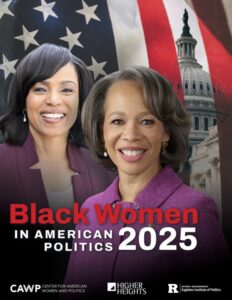
 The Higher Heights Leadership Fund and the Center for American Women and Politics (CAWP) in the Eagleton Institute of Politics at Rutgers University in New Jersey have recently released a new report examining the the progress, setbacks, and opportunities for Black women’s political representation across the United States.
Published annually since 2014, the report documents some recent key advances for Black women in American politics. There are currently 29 Black women serving as voting members and 2 serving as non-voting members in the U.S. House of Representatives. For the first time, two Black women, Angela Alsobrooks of Maryland and Lisa Blunt Rochester of Delaware, are severing simultaneously in the U.S. Senate. Black women congressional nominees were particularly successful in 2024, with 63 percent of Black women candidates for Congress winning their races, outpacing win rates for both women and men across race and ethnicity.
At the state legislative level, Black women’s representation hit a record high in 2025, representing 5.4 percent of all state legislative seats – a significant increase from their 3.5 percent representation in 2015. The top five states for Black women’s state legislative representation are Maryland (18.6 percent), Georgia (17.4 percent), Delaware (16.1 percent) Virginia (13.6 perecnt), and New York (11.3 percent).
Additionally, there have been mayoral gains in several major U.S. cities, with Black women elected or appointed as mayors in Philadelphia, Pennsylvania (Cherelle Parker), Fort Wayne, Indiana (Sharon Tucker), and Oakland, California (Barbara Lee), in 2024. Currently, Black women lead eight of the 100 most populous U.S. cities.
Conversely, the report also documents several areas where inequities remain for Black women. No Black woman has ever served as a U.S. governor, and 34 states have yet to elect a Black women to any statewide executive office. As of July 2025, there are no Black women serving in federal executive offices or in the presidential cabinet. Additionally, no Black women currently serve in legislatures in five states: Hawaii, Idaho, Montana, North Dakota, and South Dakota.
 “Black women continue to do what we have always done, lead, mobilize, and shape the future of this country,” said Glynda C. Carr, president and CEO of the Higher Heights Leadership Fund. “From the legacy of Shirley Chisholm to the ‘Kamala Effect,’ Black women have pushed the boundaries of what is possible in politics. This report is both a celebration of our progress and a call to action. We cannot rest until Black women’s representation truly reflects our power in this democracy.”

Spare us with the so-called Black American women gains politically. For starters, the two current US Senators, Rochester and Alsobrooks have literally been useless because they fail to introduce senatorial legislation specifically of native-born Black Americans. In other words, these neoliberals, are ultimately no different than their White Democrats peers and simply symbolical akin to no good a*s Obama (symbolically and no substantive policy).
In fact, these so-called Black women holding mayoral positions are no different than their so-called Black Congressional peers. As a result, the collective Black American community will be in the same political, educational, financial, and public safety quagmire for decades to come. The majority of this blame should fall on the shoulders of these quintessential sellouts from the: 1) BGLOs, 2) The Boule, 3) Black churches, 4) PHFAM & OES, and 5) Especially the HBCUs who have fallen short in truly preparing their students for the hostile and racist society in which we live.
In close, the mantra of just being happy to have “so-called Black faces in high places” is no longer acceptable nor should be tolerated by so-called Black America.
Hey Center for American Women and Politics (CAWP),
You need to revise this so-called new report for stating that the damn Brahmin/Jamaican is a Black American because that’s a boldface lie. In fact, the majority of so-called people from the continent of Africa and the Caribbean DO NOT truly work in congruence with the native born Black American community while in the USA. These historical and current scammers and deceivers only align themselves with native born Black Americans is when they can benefit fiscally or secure scholarships specifically for native born Black Americans.
The facts remain, the ethnogenesis for the native-born Black Americans is totally different from the people from the continent of Africa and the Caribbean. Can you say “They Not Like Us”?