

Since 2020, novelist and philanthropist MacKenzie Scott, the ex-wife of Jeff Bezos, founder of Amazon, has donated $19 billion to over 1,600 organizations. Included have been donations of $1,180,000,000 (as of November 15) to support historically Black colleges and universities and the organizations that represent them: the United Negro College Fund (UNCF) and the Thurgood Marshall College Fund (TMCF). This financial support is unprecedented and has solidified the finances of many of the nation’s HBCUs.
Historian Edmond W. Davis, who has taught at Arkansas Baptist College and Philander Smith University, has written that “MacKenzie Scott has done more for HBCUs than any man, woman, or person in history. No single donor in American history — not Rockefeller, Carnegie, Mellon, Vanderbilt, Morgan, Buffett, Musk, nor Gates — has ever invested more directly and broadly into Black higher education than MacKenzie Scott.”
JBHE, too, loudly applauds these extraordinary gifts to our nation’s HBCUs. Scott’s donations will enable their recipients to increase research, build infrastructure, bolster their income-producing endowments, attract esteemed faculty, and provide scholarships. One beauty of these donations is that Scott has attached no strings to the gifts. The HBCUs can use the funds as they see fit.
Currently, according to the U.S. Department of Education, there are 101 HBCUs in the United States. As of November 15, about one quarter of all HBCUs have received direct funding from MacKenzie Scott. (It must be noted that many HBCUs will receive smaller donations from the contributions made by Scott to the UNCF and the TMCF.)
The question is: Why have some universities received two major gifts, others have received one multi-million dollar donation, and other HBCUs — including some to the nation’s largest HBCUs such as Jackson State University, South Carolina State University, and Texas Southern University — have received no direct funding whatsoever?

Another JBHE reader asked:
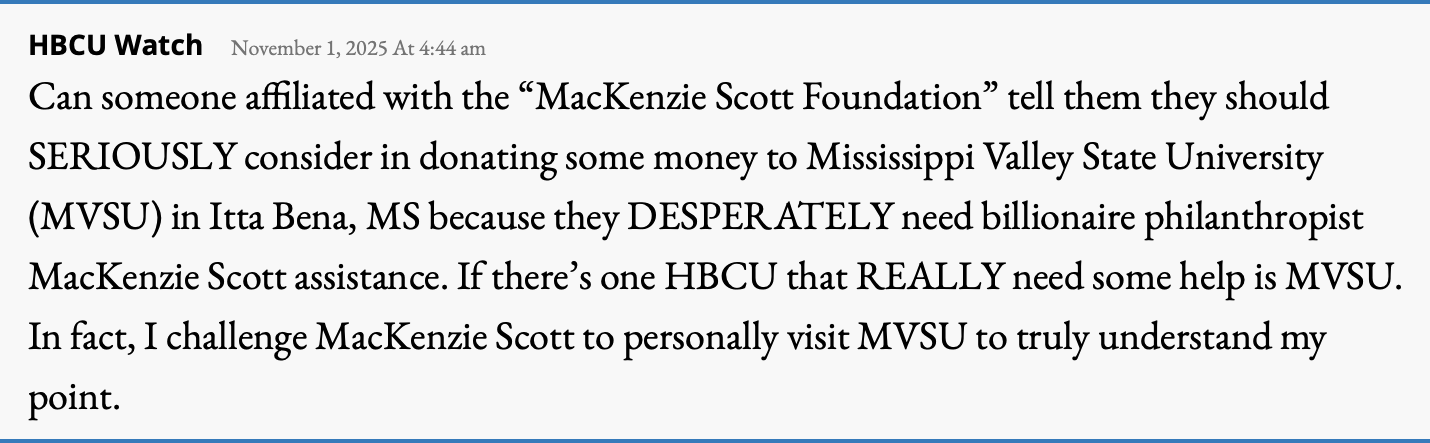
Scott’s donations have gone to both private and public educational institutions. They have gone to colleges and universities with religious affiliations and those that do not have such connections. The donations are widespread geographically and have gone to institutions with both small and large enrollments. So, are there clues to why some HBCUs have been blessed with millions of dollars and some have not, including many HBCUs that are in desperate financial conditions that threaten their accreditation and future existence?
A recent report from the Center for Minority Serving Institutions at Rutgers University in New Jersey, compared HBCUs that received donations from Scott in 2020 with HBCUs that did not receive donations from Scott. They concluded that “HBCUs with consistent leadership are more likely to receive philanthropic support. It is essential that boards of trustees choose presidents with a significant commitment to leading the institution, and that they give them the autonomy to lead.”
The authors of the Rutgers University report also stated that “philanthropists should consult data to make better informed decisions around giving, considering the donations to both high performing institutions to reward growth and lower performing institutions to stimulate growth.”
On Yield Giving, the website established by Scott to facilitate her philanthropy, it states that her team “evaluates organizations through careful analysis of criteria specific to their size, geography, and mission for indicators of high potential for sustained positive impact, including stable finances, multi-year track records, measurement and evidence of outcomes, and experienced leadership representative of the community served.”
The phrases “experienced leadership,” “stable finances,” and “high potential for sustained positive impact” stand out.
Some of the HBCUs that have not received donations have had a revolving door of leadership with many changes over the past several years. Florida Memorial University recently had a leadership crisis when some members of the board of trustees filed suit to block the appointment of a new president. The university has not received a direct donation from MacKenzie Scott.
But stable finances are probably the key factor. Scott’s donations have not gone to educational institutions that have been in financial difficulty or those that have been placed on accreditation probation in recent years, such as Saint Augustine’s University, Bennett College, Paine College, Cheyney University, and Johnson C. Smith University. And some of these schools have been taken off probation, but have not received direct donations from MacKenzie Scott. Not to mention those HBCUs, such as Knoxville College and Barber-Scotia College, that have been stripped of their accreditation but are striving to regain it. Thus, the colleges and universities that need the money the most are the ones that aren’t getting it.
This leads to the third stipulation on Yield Giving that the donations will go to those institutions that have “high potential for sustained positive impact.” In other words, Scott is not interested in shoring up HBCUs that may not survive well into the future. This is kind of a Catch-22 situation where these HBCUs need money to stay open, but they don’t get money because they may not stay open.
The UNCF reports that a majority of HBCUs have endowments of under $100 million. Several HBCUs – including Prairie View A&M University, Morgan State University, North Carolina A&T State University, and Howard University – have received over $100 million in donations just from MacKenzie Scott. Many HBCUs with small endowments — and therefore may not be on sound financial footing — are struggling to survive. For example, Talladega College in Alabama recently had to sell a section of its Amistad Murals to raise funds. Shaw University in Raleigh had to rezone its campus to allow for commercial development.
Given her vast wealth and her desire to support Black higher education, relatively small $25 million donations from MacKenzie Scott to struggling HBCUs could secure their futures.
Despite donating $19 billion over the past five years, it is estimated that due to the rise in price of Amazon stock shares that she owns, MacKenzie Scott is wealthier today than she was before she began her generous string of philanthropic gifts.

Now, we need the Federal Government & other billionaires (Gates, Scott’s ex-husband, Warren Buffett, Bloomberg) to step up. Trump said he would donate more to HBCUs?
Yes Scott is selecting ” successful institutions” for donations. She has to worry about her reputation. But that does not mean other institutions are deserving in the larger context. The US is underfunded HBCUs by 12 billion dollars. So Scott’s donations are only 10% of what is owed.
Yup. So, if Darwinism applies at all, she may indeed be selecting (creating) a group of the fittest and subsequently, determining who will survive.
It would seem sound, rational, and practical, to donate to the smaller, struggling entities. However, when dealing with large economics, you don’t make decisions using rationale and practicality. You make decision based on sound financial judgement. Anyone that has filled out a credit application knows that tangible collateral and a solid fiscal history are your best bets for getting that approval.
I wish that only a thank you was in order (i.e., the only response).
Ms. Scott: Please consider the University of the District of Columbia (UDC), Washington, DC’s only public HBCU.
The money from Ms. Scott is going to “The Talented Tenth” of HBCU’s and not to those colleges that are unable to manage a college budget effectively.
Idk how MacKenzie is selecting her schools (or if she has assigned the research to a team to make recommendations to her), but the overlooked schools need to advocate for themselves, create a campaign and reach out to her and perhaps invite her for a visit.
Thank you, Ms. Scott!!
I agree with Dr.Shirley Timmons. A Simple Thank you would be in order vs an expose’ that qualifies her philanthropy. SMH
I agree with Natalie’s comment. The worst that could happen is she answers “NO”. Considering JCSU ‘s dilemma, we have nothing to lose.
Hello everyone,
Thank you for your thoughtful remarks and posts regarding the article I wrote last month. I truly appreciate the engagement and the conversations it has sparked.
I am currently working to reach out to Ms. MacKenzie Scott and her leadership team to invite them to attend America’s only National HBCU Black Wall Street Career Fest, taking place in Little Rock, Arkansas, in April 2026.
This is an open invitation to all HBCU admissions teams, recruitment officers, and top-tier graduating seniors to join us for an unforgettable, nation-shaping experience. The event is still under the national radar—but don’t wait until you hear about it from someone else.
As the founder, I just happened to come across your remarks today, and I wanted to respond directly.
For more information, please email our team at info@hbcubws.com
.
Respectfully,
Edmond W. Davis
Founder & Executive Director
National HBCU Black Wall Street Career Fest
Thank you Ms. Scott. Happy Holidays. To
Thank you Ms. Scott!