

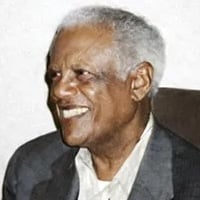
 Asmarom Legesse, professor emeritus of anthropology at Swarthmore College in Pennsylvania, passed away on January 31, just a few days before his 95th birthday.
Dr. Legesse was born in Asmara, Eritrea, in 1931 when it was an Italian colony. After graduating from Teferi Mekonnen School in Addis Ababa, Ethiopia, Dr. Legesse studied medicine as an undergraduate at Makerere University in Uganda; however, he was expelled after two years for opposing the university’s colonial curriculum. He later completed his bachelor’s degree in education from the University College of Addis Ababa. Dr. Legesse then earned a scholarship to pursue graduate studies at Harvard University, where he received his master’s degree in education in 1957. He soon began pursuing a Ph.D. and conducted field research back in East Africa with support from the National Science Foundation.
In the fall of 1968, Dr. Legesse began teaching at Swarthmore College, where he was the only Black faculty member. Early into his tenure, a group of Black students organized a sit-in protest at Swathmore’s admissions office to demand the college address several concerns. Dr. Legesse served as the faculty-student liaison. Working with these students, Dr. Legesse helped increase Black student enrollment. He also taught courses on Black studies, helped hire the first Black Cultural Center director, and served as a coordinator for the Black studies program.
After completing his Ph.D. at Harvard in 1971, Dr. Legessee left Swarthmore to hold teaching positions with Boston University and Northwestern University. In 1973, he published his first book Gada: Three Approaches to the Study of African Society (Free Press-Macmillan, 1973). Dr. Legesse spent two years living and participating in the daily life of Oromo society, followed by a stint conducting field work in Addis Ababa.
In 1976, Dr. Legesee returned to the Swarthmore faculty. While there, he urged the college to advocate for the campaign against South Africa’s apartheid system. He continued taking research trips to Eritrea, ultimately pivoting his work to fully support the liberation movement and serving nine years as chair of the Eritrean Relief Association in the United States.
After Eritrea’s formal independence from Ethiopia was declared in 1993, Dr. Legesse retired from Swarthmore to serve as academic vice president of the University of Asmara in Eritrea and as a research advisor to the Eritrean government. He also held consultancies with UNICEF, the United Nations Development Program and World Food Program, and agencies in Germany, Norway, and the United Kingdom. In 1995, Dr. Legesse returned to Swarthmore to serve as a visiting Cornell Professor, teaching courses informed by his research on food security and dislocated societies.
Throughout the remainder of his life, Dr. Legesse continued his advocacy, research, and writing. In 1998, he published The Uprooted, a series of reports on behalf of the Citizens of Peace in Eritrea concerning human rights violations of ethnic Eritrean deportees from Ethiopia. He also authored Oromo Democracy: An Indigenous African Political System (Red Sea Press, 2000) and a second edition of Gada in 2019.
In 2016, UNESCO added the Gada political system to the list of the intangible cultural heritage of humanity, citing Dr. Legesse’s work among its principal references. Dr. Legesse also received an honorary doctorate from Addis Ababa University.