

by Al-Tony Gilmore
When the NCAA’s Basketball Selection Committee announced the 68 schools to participate in its 2026 March Madness tournament, over 25 percent of the men’s teams selected had all-Black starting line-ups, and there were nine that had Black head coaches.
Exactly 60 years earlier, that was almost unfathomable. There had never been a Black head coach of a sports team at a predominately White institution of higher education (PWI). That year, Texas Western College (now the University of Texas at El Paso) became the first team to make the field with an all-Black starting line-up.
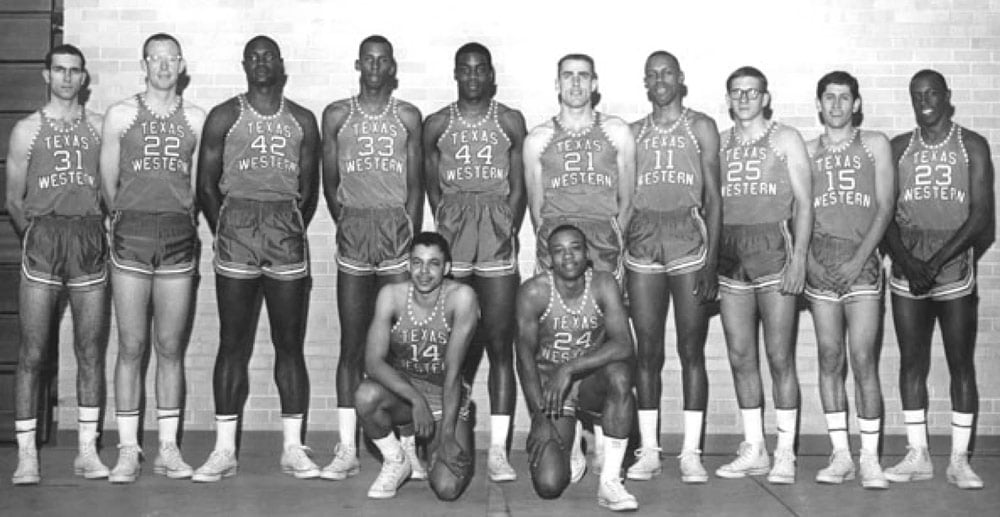
Initially, the selection did not draw much attention or cause speculation for several reasons: the school was a member of the mid-major Western Athletic Conference; it had no players projected for All-American status; it was not considered a basketball power and had never participated in the tournament; it had not been profiled by any major sports media; but most of all because they had not played in a nationally televised game prior to the tournament. They were literally “invisible men.”
Most of the nation’s sports followers had not seen them play. The team, however, gradually came across the radar screen of college basketball because they were winning by large margins and were undefeated until the last game of the season against Seattle. They entered the tournament ranked number three in the country, but deep in the shadow of Kentucky, who was ranked number one that season. The school had won four national titles, and the composition of its squad had always been all White. In fact, it was a member of the Southeastern Athletic Conference (SEC), where no school among its members had ever had a Black athlete on any team roster.
Only when the Texas Western team began its advancement towards the Final Four in nationally televised games did the Black press and Black fans – fueled by the enlightened race consciousness of the Black Power Movement – begin to wrap their hopes and dreams around the prospects of what this team could accomplish. Major sports media thought Texas Western to be a formidable team and, to its credit, made no mention of what was obvious to all watching the tournament: the team had an all-Black starting line-up, and only four White players on its roster, none of whom saw frequent game action. Other than Kentucky, the other top teams – Utah, Cincinnati and Kansas – had Black players, though most of their starters were White.
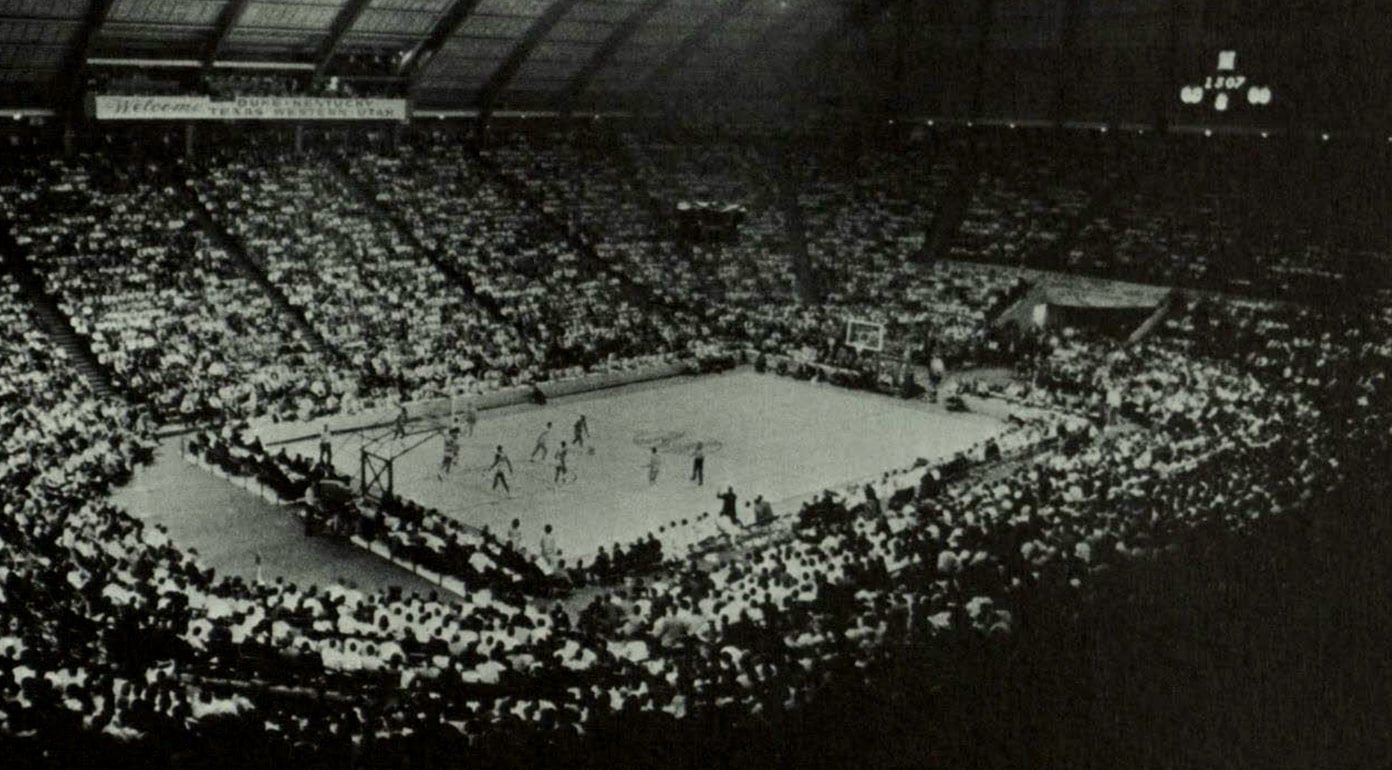
Despite its impressive regular season record, few expected – though many hoped – that Texas Western would reach the championship game. It came as no surprise, however, when Kentucky, with its legendary coach Adolph Rupp, reached the title game. At that time, no major PWI in the South had ever recruited a Black athlete, and when Texas Western advanced to the championship game played at the University of Maryland’s Cole Field House, it was a perfect storm and one symmetrically aligned with the Civil Rights Movement. In the five preceding years, most southern universities had admitted their first Black students. In Mississippi, Alabama and Georgia, federal intervention was required for their enrollment and safety. Segregation was being challenged in all areas of American life, but not without backlash and fierce resistance. It was a period when promise and peril co-existed in a tense and combustible relationship.
The March on Washington of 1963 and on Selma in 1965 led to the Civil Rights Act of 1964 and the Voting Rights Act of 1965, but the price was costly. In 1963, four young Black girls attending Sunday School in a Birmingham church were killed when a bomb planted by the Ku Klux Klan exploded. Medgar Evers was assassinated in 1963 and civil rights crusaders Andrew Goodman, James Chaney, and Michael Schwerner were killed in Mississippi in 1964, as was Viola Luizzo in 1965. The intimidation and violence were cruel, but not enough to crush the spirit of activists such as Stokley Carmichael of the Student Nonviolent Coordinating Committee (SNCC), who, in 1966, after being released from a Mississippi jail for protesting, gave an electrifying late evening speech to a crowd of Blacks. It gave both voice and identity to an angry, changing mood and to a movement when he called for Black Power.
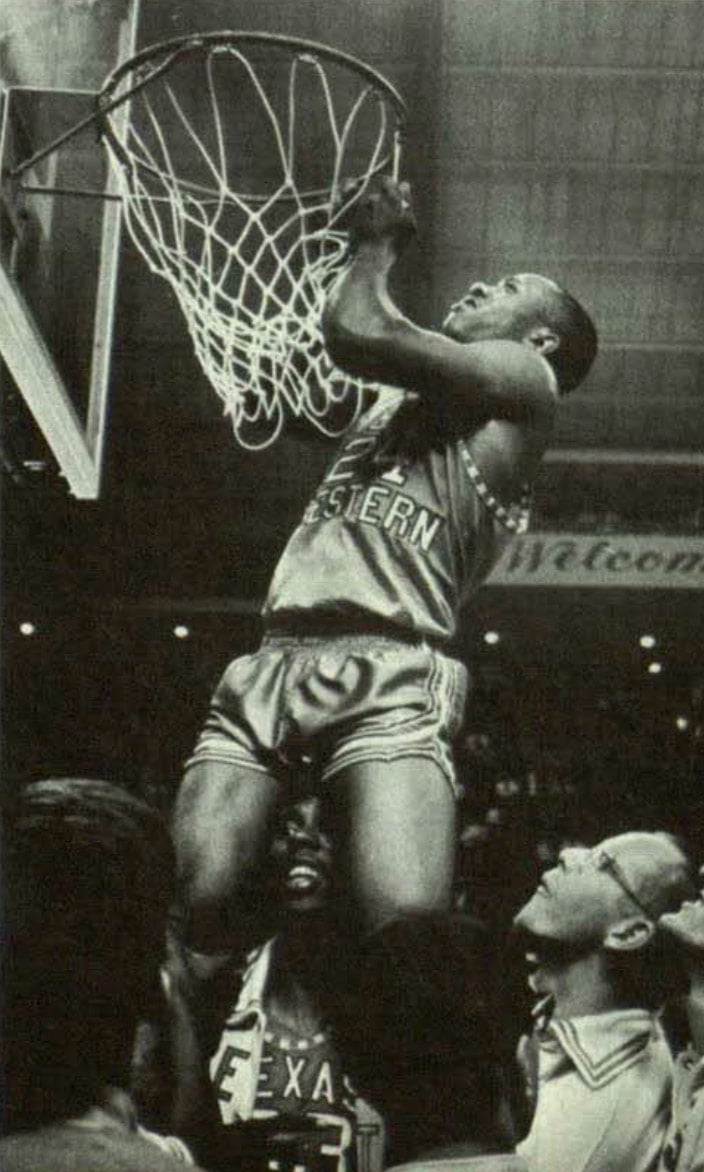
That same sentiment for political and economic empowerment found equivalent expression in the NCAA tournament as the racial composition of the Texas Western team became better known in the Black community. In an undeniably visceral way, the team soon came to represent Black Power and Black pride in college sports. Those years and events were a prologue for a game that was positioned at the intersection of sport and society and in the vortex of integration and interracial change in America.
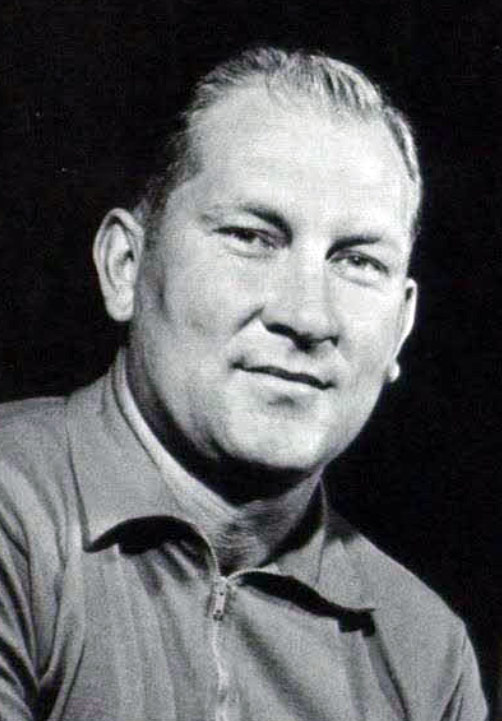
Don Haskins, the coach at Texas Western, was White and he was astute enough to exploit racism to his advantage on several levels. First, he defied the gentlemen’s agreement that there should be quotas placed on the number of Black players on a team, and he went beyond that when he placed five in his starting line-up. “I really didn’t think about starting five Black guys,” said Haskins. “I just wanted my five best guys on the court.”
Only a few teams, UCLA, Loyola of Chicago, Seattle, Cincinnati and a few others had ever had teams with more than three Black players on the court at the start of the game. His other strategic and controversial move – while deceitful and iniquitous – was psychological and employed to motivate his team. Before leaving the hotel for the game, he assembled his players and told them that Rupp was “telling people there was no way five Black players could beat five Whites.” Rupp may indeed have felt that way – as did many others of that era – but there is no evidence to support the claim that he made that specific remark. Years later, however, Haskins’ players said it was all the motivation they needed. The game was going to be about race, and on that score, they accepted the burden of race, believing they had something to prove.
Texas Western defeated Kentucky and its two All-American players, Pat Riley and Louie Dampier, by a score of 72-65. The Black newspapers, notably the Pittsburgh Courier, New York Amsterdam News, Chicago Defender, Norfolk Journal and Guide and the Washington and Baltimore Afro American, led the Black celebration of the victory. Some writers and much of the public struggled to make sense of it. One writer described the team as being able to “do more things with a basketball than a monkey on a 50-foot jungle wire.” A uniformed northern industrialist rushed a congratulatory message to Texas Western’s president, expressing excitement over the championship being won by “a small Negro college.”
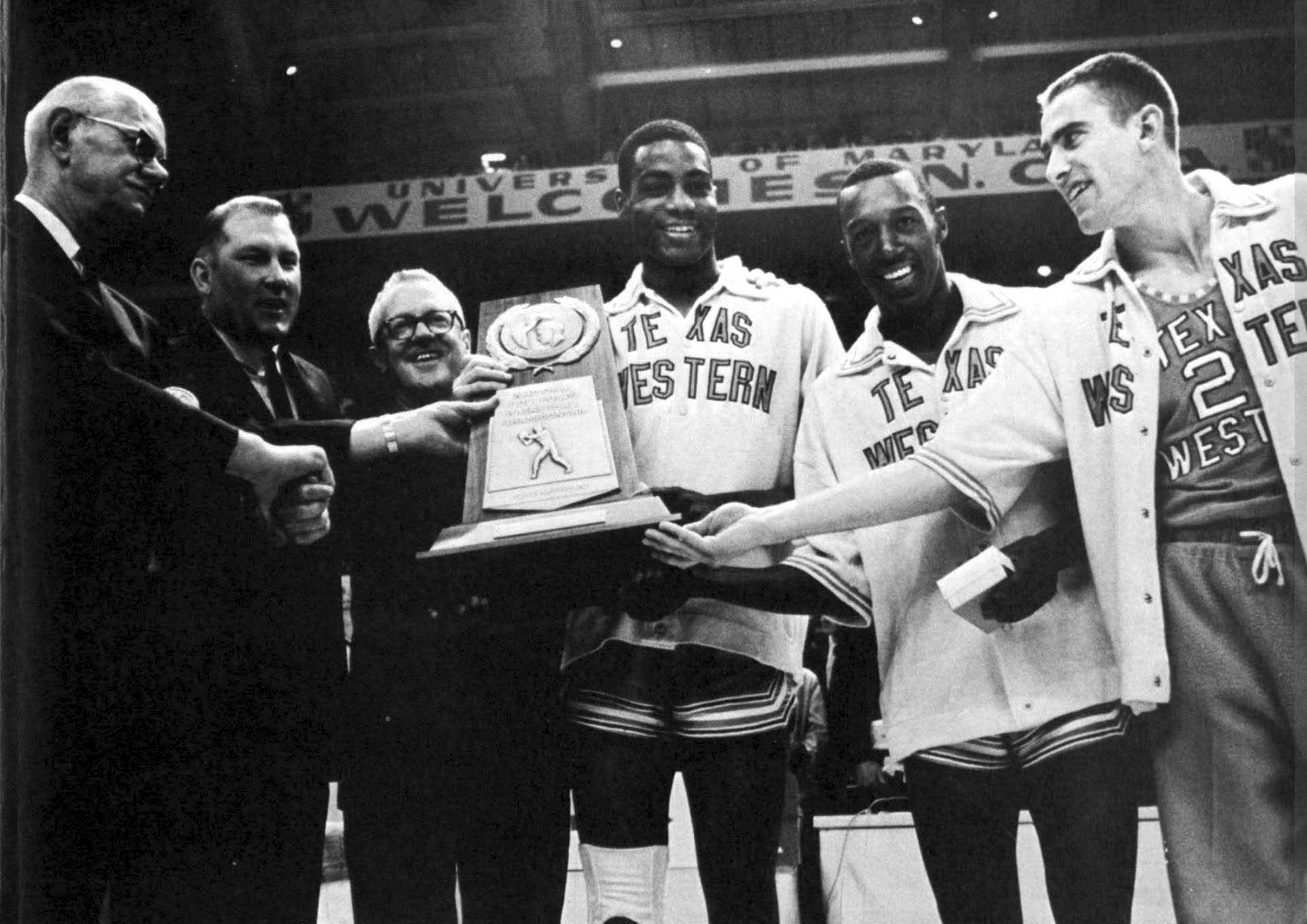
The following year, the impact of the game began to unfold. North Carolina, Vanderbilt, Wake Forest, and Baylor recruited their first Black athletes. By 1970, every major southern school was actively recruiting Black athletes. The handwriting on the wall was legible: to succeed in college athletics, the benching of Jim Crow was required. It was the beginning of a change in social attitudes and the culture of intercollegiate athletic competition that had been unimaginable in the South prior to the Texas Western and Kentucky game.
Though late is better than never, it is perplexing that it took Don Haskins’ book, Glory Road (2005) and the movie it inspired before the team would be inducted into the Naismith Memorial Basketball Hall of Fame in 2007. No doubt the inexcusable delay was caused by the strong residue of those who hastened to forget the game ever occurred. Texas Western was not embraced by America or the sports media, and some even discredited the recognition of their victory. There were segments of the nation which experienced cognitive dissonance over the unsettling loss and it became contagious, spreading like an epidemic.
Ed Sullivan never invited the NCAA champions to appear on his program, which had been a customary practice. It was as if something was suspect or unacceptable about the team. James Michener, in his book, Sports in America (1976), questioned the integrity of Haskins’ recruitment of Black players whom he had the audacity to suggest were not legitimate college students. The game, he wrote, “was one of the most wretched episodes in the history of American sports.” Sports Illustrated also argued that none of the Texas Western players were “real students.” Such reporting unfairly diminished the title. Adolph Rupp further contributed to the tarnishing, outrageously claiming that one of the players was recruited out of prison. It would be a generation later before mainstream media reported that five of the seven Black players graduated, compared to four of the five Rupp starters never graduating from Kentucky.
It is unfortunate that the original film of the game has deteriorated in quality. It easily qualifies as a national treasure, and deserves restoration so that future generations can see it as it was once seen. The American Film Institute, Library of Congress and others have remastered many films considered important for posterity, some of which even project pejorative images of Blacks, such as Gone with the Wind, Song of the South, and Birth of a Nation. Surely, this game, too, is a part of our heritage. It ignited consequential social change and should be valued for the lessons we learn from it. Our nation became a better place sooner, because of that single game. it remains a teachable moment. Given the enormous resources of the NCAA, ESPN, and the NBA, the restoration is long overdue.
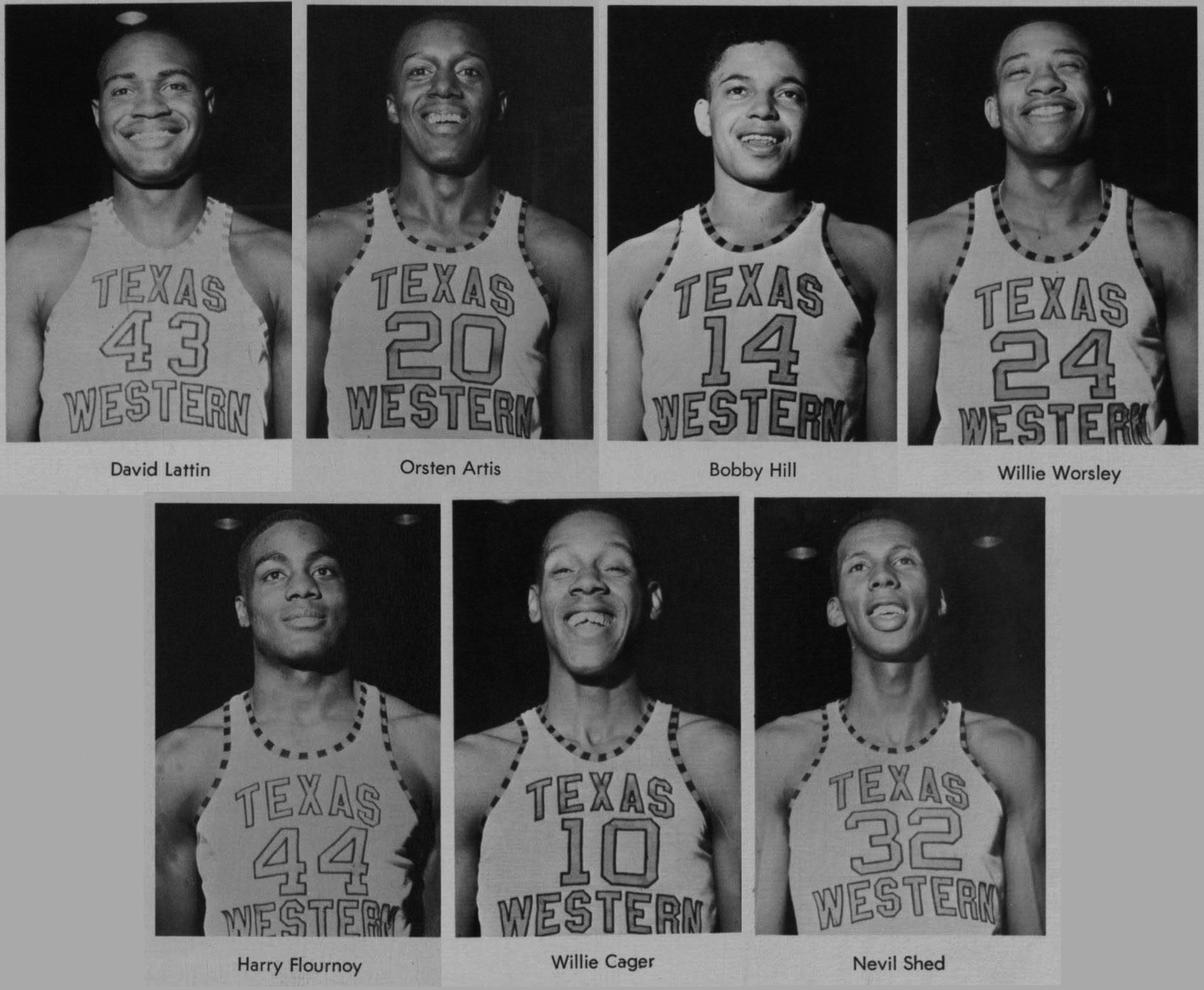
This game matters and the courage of Don Haskins and the seven Black players who participated in it should be remembered and respected: David Lattin, Orstein Artis, Bobby Joe Hill, Willie Worsley, Harry Flournoy, Willie Cager, and Nevil Shed. And on the 60th anniversary of Texas Western College becoming the NCAA Basketball champion, it has proven to be the game that benched Jim Crow, changing college basketball forever.
 Al-Tony Gilmore is Distinguished Historian Emeritus of the National Education Association. He has served a history professor at Howard University, University of Maryland at College Park and as a visiting scholar at George Washington University. His books include Bad Nigger: The National Impact of Jack Johnson (1975), Revisiting The Slave Community (1978), All The People (2008), A More Perfect Union (2012), The NEA and ATA: A Biographical Directory (2011). His reviews, articles and commentary have appeared The New York Times, Washington Post, New Republic, American Scholar, and the Huffington Post. and in the leading historical and academic journals. He writes widely on American history, popular culture, and HBCUs. Gilmore was the first scholar to explore the intersection of sports, society and social history and developed the first college-level course on The History and Politics of the Black Athlete in America. Dr. Gilmore was curator for a widely acclaimed exhibit on voter suppression, which appeared at the Maltz Jewish Museum in Cleveland, Ohio, and at the Skirball Museum in Los Angeles, California. He established the Al-Tony Gilmore Endowed Scholarship at North Carolina Central University for students majoring in history.