

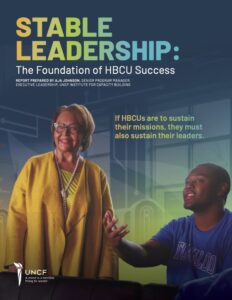
 The Institute for Capacity Building at the United Negro College Fund (UNCF) has released a new report, “Stable Leadership: The Foundation of HBCU Success,” analyzing the average presidential tenure at historically Black colleges and universities.
According to the report, the average tenure of a college president in the United States is 5.9 years. However, the average HBCU president serves an average of 4.22 years. Presidents of private HBCUs have an average tenure of 4.42 years, while public HBCU presidents average 4 years of service.
Furthermore, across UNCF’s 37 member institutions, presidential tenure is even shorter, averaging just 3 years of service. However, of these 37 presidents, the tenure of 11 who bring prior presidential experience averages 10 years. Of those 11 presidents, 10 have served in their current role at their UNCF member institution for an average of 8 years.
“This variation highlights that there are pockets of stability, whether through prior experience or longer institutional tenure, that play a critical role in ensuring continuity, strategic vision, and institutional stability at HBCUs,” write the report authors. “While a handful of presidents have served for a decade or longer, many others leave after only a few years. These discrepancies reflect deeper structural realities: institutional instability, fraught governance relationships, and external pressures that directly shape the length and success of presidencies.”
To improve presidential tenure at HBCUs, the UNCF outlines four key strategic areas of focus. This includes improving presidential searches by ensuring search committees have a better understanding of the process and prioritizing leaders with prior presidential experience. The report authors also call for institutions to strengthen their onboarding, as well as the support resources and mentorship opportunities for new presidents. Additionally, the authors highlight the need for effective board governance and stronger collaboration between presidents, board members, and support organizations. Finally, the authors call for more research on this subject, which could provide greater insights into the nuances specific to HBCU leadership.