

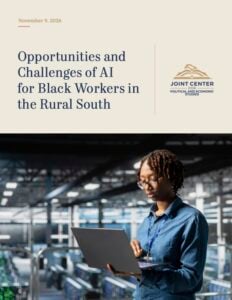
 The Joint Center for Political and Economic Studies has published a new report examining how artificial intelligence, automation, and data center development are reshaping economic opportunities and challenges for Black workers in the rural South.
The report states that “AI data center growth is highest in the South, and the South has the highest concentration of Black rural workers,” which places the Black rural workforce “at the center of the AI and automation revolution where they work and live.” To better understand the AI landscape for Black non-urban workers, the Joint Center conducted interviews with professionals who represent nonprofit organizations in higher education, workforce development, and technology with a focus on rural communities and their residents. These professionals were primarily located in Alabama, a state where African Americans represent more than 40 percent of the rural population and where there is a high prevalence of industries at the center of AI growth, such as aerospace, automotive, and advanced manufacturing.
Across these interviews, there were four key themes that illuminated Black rural workers’ perceptions of AI in their communities: curiosity, caution, culture, and collaboration. The Black rural workforce has expressed interest in learning what AI can do for them in their professional and personal lives. At the same time, Black rural communities are also wary about the environmental and economic impacts of the technology, as well as the underrepresentation of rural voices in shaping AI systems. Furthermore, AI-driven land acquisition threatens to erode the cultural fabric of Black communities, many of whom have held generational land ties. Despite their concerns, Black rural communities want to be active partners in AI’s revolution and want transparent and community-driven AI programming.
Based on the insights gathered from these interviews, the Joint Center advocates for Community Benefit Agreements (CBAs), legally binding agreements between local communities and private entities, as the central mechanism for protecting Black rural workers while sharing the benefits of technological growth. These agreements would guide the economic, employment, environmental, educational, and enforcement protocols for AI development projects in mutually advantageous ways.
“African Americans, who have decades of evidence of environmental racism and economic disenfranchisement, cannot afford to be left out of the AI conversation, present and future,” the authors conclude. “Legally binding CBAs are a powerful tool that ensures rural communities do not have to choose between employment and quality of life. Integrating rural communities, on every level, from app development, reskilling and upskilling, and large language model development, is essential. Otherwise, this AI revolution will be just another story of gentrification where residents are left behind and not able to participate in its growth or derive its benefits.”
The full report, “Opportunities and Challenges of AI for Black Workers in the Rural South,” includes more insights and direct quotes from the community interviews as well as detailed policy recommendations for federal, state, and local governments.