

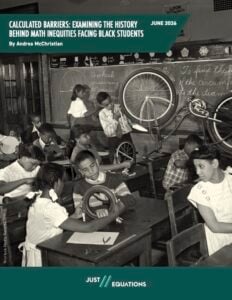
 Andrea McChristian, national policy director at Just Equations, has authored a new report examining the educational policies and practices that have led to persistent math inequities among Black students in the United States.
“Math literacy is essential in the twenty-first century to help us understand the world and meaningfully participate in our democracy,” writes McChristian. “Numeracy skills are also critical for employment success, with AI and other technological innovations demanding a workforce that can engage in quantitative reasoning and data analysis. A high-quality math education is thus critical to preparing students for civic engagement and fulfilling careers.”
In her report, McChristian outlines several barriers to high-quality middle and high school math education for Black students, which have compounding implications for Black students’ ability to take advanced STEM courses in college. Early access to Algebra I has been linked to advanced math course-taking in high school and higher college readiness. In order to take advanced courses before college, students must take Algebra I in middle school.
According to McChristian, Black students are disproportionately less likely to take and pass eighth-grade Algebra I than their White and Asian peers, partially due to the course’s limited availability in schools with greater shares of Black students. However, many Black students who have demonstrated readiness to take Algebra I in eighth grade do not take the course, possibly due to systemic biases in placement practices or a lack of information about course options. During the 2020–2021 academic year, Black students represented some 15 percent of all eighth graders, but only 9.1 percent of eighth graders who passed Algebra I. In comparison, Asian and White students represented 5 percent and 46 percent of all eighth graders, respectively, but 8.8 percent and 53.6 percent of those who passed Algebra I.
This disparity results in even worse inequities in Black students’ access to Algebra II and more advanced courses like statistics, data science, precalculus, and calculus — classes that are often used by colleges and universities as an admissions screen, interpreting such courses as proof that students can handle rigorous coursework. Even among Black students who do enroll in college with goals of obtaining a STEM degree, many cannot access calculus early into their studies. Instead, these students are often required to take lengthy prerequisite sequences, thereby delaying their path to a degree.
“Providing access to a quality math education for all Black students requires a transformation of our entire math education system, including dismantling the gatekeepers that perpetuate inequity,” writes McChristian. “It must be grounded in the belief that all students are capable of math success when provided with the proper support. In addition to helping Black students, such changes stand to benefit other groups that also have been excluded from math opportunity.”
 McChristian is a graduate of Yale University, where she earned her bachelor’s degree in political science. She holds a master’s degree in early childhood education from the University of Nevada-Las Vegas and a juris doctorate from Columbia Law School. Before joining Just Equations, she served as the policy research director at the Southern Poverty Law Center. Earlier, she was the law and policy director for the New Jersey Institute for Social Justice.