

by Jaret C. Riddick, Luke Brazinski, Chad Womack, and Tyrome Smith
In 1980, Congress passed two landmark laws that reshaped how universities patent, license, and commercialize intellectual property (IP) from federally funded research.
Newly aggregated data shows that despite persistent underfunding, the nation’s historically Black colleges and universities (HBCUs) have increased their patent applications significantly over the past 25 years. This strong performance is an underutilized national asset, and one the United States cannot afford to ignore as global competition for innovation intensifies.
The Bayh-Dole Act allows universities and small businesses to own and license inventions created with federal funding. The Stevenson-Wydler Act makes technology transfer a core mission of federal laboratories. According to the Government Accountability Office, before the enactment of these laws in 1980, the federal government had licensed fewer than 5 percent of its 28,000 patents. Bayh-Dole alone is credited with contributing over $1.3 trillion in U.S. economic growth and supporting more than 4 million jobs.
While America’s top research institutions have grown their coffers by mastering licensing and commercialization efforts, similar benefits have eluded the nation’s HBCUs. Founded primarily as teaching institutions, America’s HBCUs have pursued a mission of educating excellent talent in many fields of endeavor for over 150 years. Along the way, federal support has also bred an HBCU research and development (R&D) enterprise responsible for producing high-level talent and countless technological innovations.
Arrowpoint Labs, an Alabama-based advisory firm, has documented a surge in HBCU patent applications since 2000. The finding points to unrealized value in licensing and commercialization from the nation’s HBCU R&D investment. The economic potential is substantial. According to a recent analysis from the Association of University Technology Managers (AUTM), technology transfer to market generated $2.94 billion in licensing in 2018. Assuming a 2 percent royalty rate, $147 billion in sales derived from academic technology is required to produce this level of licensing revenue.
In the years from 2008-2018, Northwestern University earned nearly $3 billion from fewer than 500 licenses, both exclusive and non-exclusive. In that same time period, Stanford University netted nearly $1 billion from nearly 1,000 licenses and the Massachusetts Institute of Technology netted closer to $500 million with nearly 3,000 licenses.
The U.S. invests more than $100 billion annually in research across universities and federal laboratories; more than a trillion dollars cumulatively over 15 years. While no straight line connects federal R&D dollars to patent applications to licensing revenue, sustained investment has clearly created the conditions under which academic research generates commercial results.
Against this backdrop, HBCU research funding remains historically low. According to the National Science Foundation’s Higher Education R&D (HERD) Survey, federally financed R&D at U.S. universities totaled $59.4 billion for fiscal year 2023. HBCUs made up about 6 percent of institutions reporting R&D expenditure in the HERD survey that year. Combined, they received only about $540 million — less than 1 percent of total federal university R&D, or under a penny of every federal research dollar.
Even so, a record 13 HBCUs now hold the R2 Carnegie classification for “high research activity,” and Howard University recently regained the gold standard R1 status signifying “very high research activity.” Research across this R&D enterprise, including leading HBCU medical schools, produces a valuable portfolio of discoveries ready for commercialization. Without technology transfer infrastructure, that value remains an unrealized national asset.
The newly aggregated data from Arrowpoint Labs shows that HBCUs are already producing substantial innovation activity with 1,106 total patent applications filed between 2001 and 2025. Arrowpoint Labs examined U.S. Patent and Trademark Office (USPTO) data covering 30 HBCUs, of which 21 had USPTO patent activity in the 2001–2025 period. The data shows applications across fields with commercial and national security implications, such as medical science, biotechnology, agriculture and computing, with sustained growth from 2005 through 2021 and peak filing activity from 2019 to 2021.
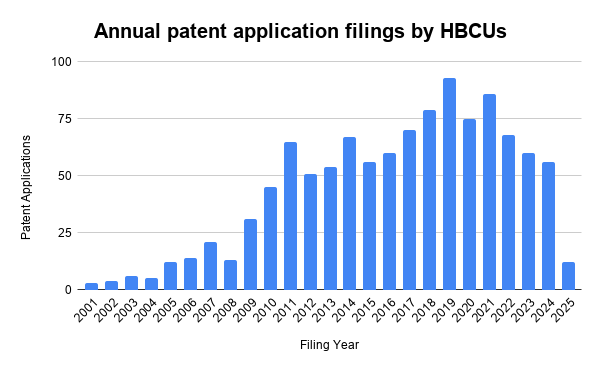
Annual patent application filings by HBCUs, 2001 through 2025 (1,106 total applications). The apparent decline after 2021 partly reflects a known lag in the publication of data.
Source: Arrowpoint Labs analysis of U.S. Patent and Trademark Office data
Because most HBCU reporting tracks granted patents, the 1,106 applications filed between 2001 and 2025 reveal a pipeline far larger than the record suggests. The Arrowpoint Labs analysis measures activity at an earlier point in the pipeline: the patent application. Converting applications into granted patents and licensed IP requires infrastructure most HBCUs lack. Until this gap is filled, commercial value will continue to be left on the table.
Patent application activity is concentrated, but the pipeline runs deep. Morehouse School of Medicine, Howard University, and Florida A&M University account for more than a third of applications. North Carolina A&T State University and Morgan State University, both R2 institutions on the cusp of R1, are among the top five filers. Several schools aspiring to R2, including Xavier University of Louisiana, Tuskegee University, and Fayetteville State University, show expanding portfolios.
The gains from commercialization can expand the HBCU R&D enterprise, strengthen local economies, and enhance national security. The pipeline is there. The path to market is not.
To scale these gains, policymakers across government, industry, and academia should partner now to build the structures needed to translate research outputs into licensable IP. The returns should flow back into the institutions that created them in order to sustain the mission. Specifically, policymakers should begin now to establish conditions for the commercialization of HBCU R&D that:
- Honor the teaching mission by connecting classroom to laboratory
- Expand federal and state funding for patent prosecution and licensing,
- Build pathways for industry to engage with HBCU R&D, and
- Connect HBCU innovations to investment markets and capital.
Dr. Jaret C. Riddick is the former Pentagon Principal Director for Autonomy and the current Principal of RB MECK, a D.C.-based research and advisory practice.
Luke Brazinski is the associate director of Arrowpoint Labs, an Alabama-based advisory firm.
Dr. Chad Womack is a life scientist and the founder of the ARN Research Group.
Tyrome Smith is the interim director of economic development and strategic partnerships at Bowie State University in Maryland.