

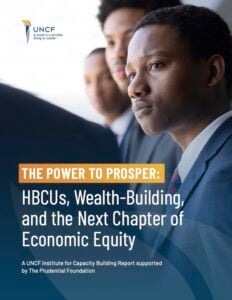
 A new report from the United Negro College Fund’s (UNCF) Institute for Capacity Building explores how historically Black colleges and universities can integrate wealth-building into their institutional functions and support financial literacy among their students, faculty, and staff. Drawing from survey and focus group data on students, faculty, and staff across 44 institutions, the report authors identified several existing financial strengths and areas of opportunity to advance wealth-building at HBCUs.
Although nearly all HBCUs included in the study offer some form of financial wellness or benefits programming, less than a quarter track program participation or evaluate their impact. Many of these programs are spread out across departments (such as human resources, financial aid, and advancement) with little cross-functional coordination. Very few institutions have integrated financial wellness into their strategic plans.
Regardless of income level, 89 percent of students and 81 percent of faculty and staff reported financial stress. For students, many reported concerns with the high cost of living, debt, and unpredictable income, while faculty and staff struggle with stagnant wages, rising housing costs, and limited retirement savings. Less than half (43.6 percent) of students and two-thirds of faculty and staff say they are prepared to handle a $1,000 emergency.
Despite nearly all HBCUs offering financial wellness programs, 47 percent of students and 38 percent of staff were unaware of these programs. Among those who were aware, 17 percent of students and 19.2 percent of faculty and staff say they have used available financial resources, even though more than 85 percent say wealth-building is important.
Across all participants, the majority expressed interest in participating in experiential learning opportunities regarding wealth-building, such as simulations in budgeting, credit management, and salary negotiation for students. Among working professionals at HBCUs, many requested guidance on retirement planning, benefits optimization, and home ownership.
In addition to engagement with HBCU campus communities, the report authors also consulted a financial advisory board regarding potential avenues for increasing HBCUs’ wealth-building opportunities. According to those experts, wealth-building must be defined as more than just financial gain, centering educational access, family well-being, and community impact as key factors for building collective wealth. Some examples include tuition remission and dependent education benefits for HBCU employees, endowment growth to strengthen institutional longevity, and community outreach programs regarding financial literacy, entrepreneurship, and home ownership.
“America stands at a defining moment. The racial wealth gap, though centuries in the making, need not be centuries in closing,” the authors write. “The tools, knowledge, and commitment exist — but they must be aligned through institutions with credibility and reach. HBCUs have both. They are deeply rooted in communities that mainstream financial systems too often overlook. They are trusted by the very populations policymakers and investors most struggle to reach. And they are proven multipliers of social and economic mobility. With strategic investment and sustained partnership, HBCUs can become the nation’s most powerful laboratories for inclusive prosperity — demonstrating how education, trust, and equity combine to generate lasting wealth.”