

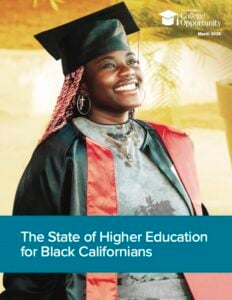
 The Campaign for College Opportunity has released “The State of Higher Education for Black Californians,” a new analysis of the recent progress and lingering racial disparities in K-12 preparation, college access and enrollment, transfer outcomes, and degree completion rates among the state’s Black population.
Some 82 percent of Black public high school seniors in California graduated in 2025, with 45 percent of those students having met their A-G requirements (the minimum threshold for admission to the University of California and California State University systems). Both of these percentages represent an all-time high.
Overall, students who meet the A-G requirements are more likely to attend college than those who do not. Some 82 percent of Black students who met those requirements enrolled within one year of graduation, compared to 42 percent of Black students who did not. Among White students, the same figures were 87 percent and 50 percent, respectively.
Black students who do enroll in college are most likely to attend a public college or university. Over three-quarters of Black undergraduates in California attend a public institution, with 66 percent of Black undergraduates attending a California community college. Some 13 percent of Black undergraduates attend a for-profit institution, compared to 6 percent of all Californian students. Among undergraduates at four-year institutions, 42 percent of Black students attend a public university, compared to two-thirds of all students in the state.
At community colleges, Black students have seen significant progress in the completion rates of transfer-level courses. Over 99 percent of Black community college students enrolled directly into transfer-level English and math courses, compared to just 15 percent and 12 percent in 2015, respectively. Simultaneously, completion rates for Black students in these courses have spiked by 20 percentage points for English and 35 percentage points for math since fall 2016. Yet, these completion rates remain below those of the White population and the overall student population.
Despite modest increases in recent years, less than one in seven Black community college students earn a degree or certificate within six years, compared to one in four of their White peers. Only 40 percent of Black community college graduates earn an associate degree or transfer, which is below the statewide rate of 47 percent.
At campuses of the California State University System, 24 percent of Black freshmen from the 2021 cohort graduated within four years, up 50 percent from six years prior. Notably, wages for Black graduates of both the University of California and California State University Systems exceed the state’s median yearly earnings within five years of graduation. However, the six-year graduate rates for Black students at California State University institutions have decreased slightly over the past decade. Also, the gaps in graduation rates between Black and White students after both four and six years have slightly widened. According to the report, no higher education system in California has a gap in its graduation rates between Black and White students of less than 10 percentage points.
Currently, about 31 percent of working-age Black Californians have a bachelor’s degree — a five percentage point increase since 2018 but far below the rates for White (49 percent) and Asian (61 percent) Californians. Over one-quarter of Black Californians have attended college without earning a degree, which is the highest non-completion rate of any racial/ethnic group in the state.
“Higher education remains one of California’s most powerful equity levers for expanding economic opportunity, earning potential, and upward mobility,” the authors write. “However, the full promise of higher education can only be achieved when Black students are equipped with the resources, support, and institutional commitment to thrive.”
They continue, “Black students continue to encounter systemic barriers at every stage of the educational pipeline that restrict enrollment and impact persistence and completion rates. California’s future depends on the investments made today and campuses’ commitment to create inclusive learning environments. The progress being made is admirable, but lasting change requires intentional and sustained investment and accountability.”