

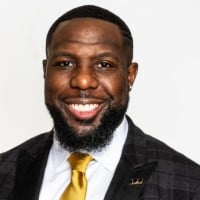
 Wes Bellamy, associate professor and executive director of the John Mercer Langston Institute for African American Political Leadership at Virginia State University, has authored a new report examining the current economic conditions facing Black men and boys in the United States.
As of July 1, 2025, there are some 46.2 million Black Americans living in the U.S., 49 percent of whom (22.7 million) are Black men and boys. Overall, the Black population is young; roughly one in five Black Americans is under the age of 18.
According to Dr. Bellamy’s report, there are significant racial disparities in early literacy and K-12 education for both Black boys and girls. Only 17 percent of Black fourth graders and 14 percent of Black eighth graders performed at or above the proficient achievement level of the National Assessment of Educational Progress in 2024. More than six in 10 Black eighth graders performed below the NAEP basic level. Notably, Black students made meaningful gains in reading performance between the 1990s and the mid-2010s, but progress has since stalled. Black students are significantly more likely than their White peers to attend high-poverty schools (37 percent versus 7 percent).
In postsecondary education, there was a 22 percent decline in Black male enrollment between 2010 and 2022. At HBCUs, Black male enrollment has declined from 38 percent in 1976 to 26 percent in 2022. The share of non-Black students attending HBCUs is now approximately equal to the share of Black male students. These enrollment patterns have led to consequences in degree attainment. Among Black adults ages 25 to 34, slightly over one-quarter of Black men hold a bachelor’s degree or higher, compared to 38 percent of Black women.
As of June 2026, the Black unemployment rate is 6.6 percent. In comparison, the current unemployment rate is 5.6 percent for Hispanic Americans, 3.9 percent for Asian Americans, and 3.6 percent for White Americans. Between the first quarter of 2025 and the first quarter of 2026, the employment-to-population ratio for Black men declined from 60.5 percent to 58.8 percent, while the ratio for Black women stayed at roughly 56.4 percent.
As of 2025, the median weekly earnings for Black men working full-time was $1,039. In contrast, the median weekly earnings for White men was $1,354. Thus, Black men earn some 77 cents for every one dollar earned by White men. Within the Black population, women earn about 91 cents for every one dollar earned by men. In 2024, median household income for Black households was about $56,000, compared to some $88,000 for White households and $121,700 for Asian households. Black median household income dropped by more than 3 percent from 2023 to 2024.
Looking beyond income, Dr. Bellamy also found major disparities in several measures of household wealth. The median transaction-account balance is $2,200 for Black families and $10,000 for White families. Some 43 percent of Black families own a home, compared to 73 percent of White families. Additionally, Black families have lower median stock holdings, lower median home equity, and higher levels of student-loan debt than White families.

Hey Wes,
Your fragmented study is literally no different than what the MISLEADING National Urban League (NUL) has been producing for decades about the “plight of Black men in the US”. I would venture in saying that your study (if you want to call it that) is a classic example of 2026 deficient narrative report all the while you fail to critically address the root cause of such issues from: 1) institutional and systemic racism, 2) employment discrimination, 3) housing discrimination, 4) the rapacious Prison Industrial Complex, and 5) the impact of living in a society that saturated with normalized deviant behavior from materialism, violence, drugs, music and social media.
In lieu of the aforementioned Wes, you fail to mention the role Black people, Black families, and the collective Black communities can reverse each of these areas of concerns. In other words, the so-called BLACK AMERICAN COMMUNITY will have to IMMEDIATELY cease from willingly participating in their own demise from participating in self-destructive behavior as manufactured by WHITE AMERICA. Further, so-called BLACK AMERICA must have a deep mental cleansing in order change the current negative narrative that has become widely accepted within this society. When that narrative changes, the rest of this White society will change in how she portrays Black America because it will not be tolerated in any capacity from anyone.
Hey, many of these items are included in the study… I would suggest reading it in its entirety.
Much Love,
Dr. Wes Bellamy
Dr. Wes, I really appreciate your commitment and the study. I had a chance to hear you today on the Lurie Daniel Favor morning show and you are on point that these issues need to be pointed out in our community and addressed. You keep fighting for our community. One thing I think is important is that we need to educate our own through Freedom Schools.